
When Jesus Became God
The most exalted and influential view of Jesus’s divinity appears in a first-century incarnation hymn embedded in the Gospel of John.

Reading the gospels one Christmas season about a dozen years ago, I was struck by the majesty and the message of the opening verses of the Gospel According to John, known as the “Prologue of John.” In eighteen sonorous verses it begins by stating that Jesus of Nazareth was the human incarnation of the “Word of God,” and had existed since the beginning of time. I am far from the only person who has had that reaction: The Prologue, by itself, has spawned a vast number of commentaries, devotional essays, scholarly papers and analyses, and dozens of books.
If you read the New Testament in the format that has come down us it takes a while to get to the Gospel of John, the fourth gospel. The first three, Matthew, Mark and Luke, have many similarities, and are often referred to together as “the synoptic gospels” (meaning, “from the same point of view”). Scholars have concluded that Mark was written first, followed by Matthew and Luke, both of whom followed Mark’s content and outline—often copying passages and whole stories word for word. Both also added their own material, including their conflicting nativity stories and genealogies of Jesus.
Jesus appears in Mark as an apocalyptic prophet, warning that the end of time is near. In Matthew and Luke, he emerges as the messiah—the anointed one, foretold as the future king of Israel by the prophets of the Hebrew Bible—with additional material on his biography and religious and ethical teaching.
But is he a god? The first three gospels keep you guessing. In some places, Jesus seems to become a god at the moment of his baptism, in others at the moment of his birth or conception, or perhaps when he is resurrected after the crucifixion. But in none of them does he himself claim to be a god.
It is only in the Gospel of John that he is presented not only as a god, but as God himself. In the Prologue, as the New Testament scholar Bart. D. Ehrmann explains: “Here, Jesus is decidedly God and is in fact equal with God the Father—before coming into the world, and after he leaves the world.”
Intrigued as I was when I focused on the Prologue those many years ago, there were a few things about it that gave me pause. I have spent most of my adult life as a writer and editor (newspapers, magazines, and books), and several of those eighteen verses—particularly the ones that insert a narrative about John the Baptist—didn’t seem to sit well stylistically with the other verses. I did a bit of web surfing, and found that some scholars thought the material about John the Baptist as well as the final few verses might have been later additions to an earlier work.
I tried deleting those verses, and found that this tighter, edited version not only held together logically, but also flowed much more poetically. I saved it as a Word document (appropriately enough) on my computer desktop, and read it often, particularly over the Christmas season. Eventually, I came to realize that it had replaced the nativity stories in Matthew and Luke in my spiritual imagination of the origin story of Jesus Christ.
Before saying more about the prologue itself and its theological influence, here is the edited version I produced, shorn of the uncertain lines. In my experience, it is rarely presented this way, even in articles and papers that argue that it is likely the original writing:
1 In the beginning was the Word, and the Word was with God, and the Word was God.
2 He was with God in the beginning.
3 All things came to be through him, and without him nothing came to be.
4 In him was life, and the life was the light of all people.
5 And the light shines in the darkness, and the darkness has not overcome it.
10 He was in the world, and the world came to be through him, but the world did not know him.
11 He came unto his own, and his own did not accept him.
12 But to those who did accept him he gave power to become children of God.
14 And the Word became flesh and dwelled among us, and we saw his glory, the glory of one unique from the Father, full of grace and truth.
The translation is an amalgamation of several English versions. The deleted verses will be referenced below, and the longer version that includes them can be found in any standard New Testament).
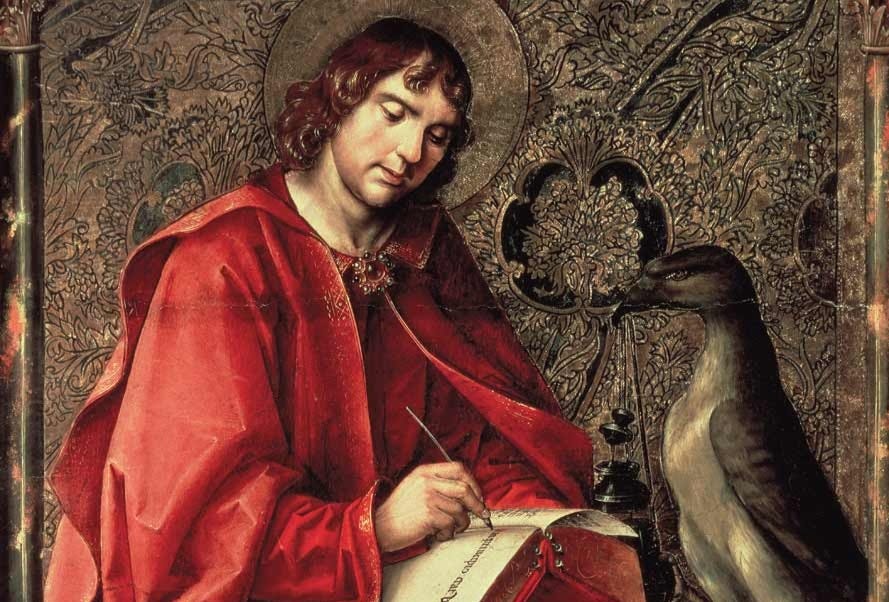
St. John the Evangelist, undated, from the St. Thomas altarpiece by the Spanish painter Pedro Berruguete (c. 1450 – 1504). John is often depicted with an eagle, symbolizing divine revelation and spiritual vision.
Reconstructing the Original
As I began studying early Christianity more intensively over the last few years, I discovered that many scholars—both modern critical scholars of early Christianity, as well as more traditional scholars whose backgrounds are firmly rooted in established church traditions—have been convinced since the mid-twentieth century that the shorter version of the Prologue presented above (or something very similar) was an existing composition when the Gospel of John was composed. Either the author or authors (some scholars think there was more than one) or a later editor, they hypothesize, had adapted it to serve as an introduction. Many believe it was an early Christian hymn to Jesus that was sung by his followers, and was expanded to weave in information about John the Baptist.
In his massive commentary on the Gospel of John (two volumes filling 1,207 pages of the Anchor Bible series), the late Raymond E. Brown—a Roman Catholic priest who was one of the twentieth century’s most influential New Testament scholars—reviewed the research of a cross section of leading scholars up to his time (his first volume was published in 1966). All the scholars he cited agreed that the verses about John the Baptist were “secondary additions.” The first four inserted verses come after the second stanza in the version above.
(6 There was sent by God a man named John 7 who came as a witness to testify to the light so that through him all men might believe—8 but only to testify to the light, for he himself was not the light. 9 The real light which gives light to every man was coming into the world.)
The fifth inserted verse comes after the third stanza:
(15 John testified to him by proclaiming: “This is he of whom I said, ‘The one who comes after me ranks ahead of me, for he existed before me.’ ”)
The last three verses, which seem more like explication than poetry, were likely inserted to end the Prologue as it appears in the New Testament):
(16 And of his fullness we have all had a share—love in place of love. 17 For while the Law was a gift through Moses, this enduring love came through Jesus Christ. 18 No one has ever seen God; it is God the only Son, ever at the Father’s side, who has revealed Him.)
From Raymond E. Brown’s translation.
Brown notes that the scholars he cites had differing opinions on whether these last three verses were original. He himself opted to included verse 16, but he notes that “the only general agreement is on vss. 1-5, 10-12, and 14 as parts of the original poem.”
As for the methodology used in identifying the insertions, Brown writes that “the principal criterion is the poetic quality of the lines (length, number of accents, co-ordination, etc.),” and admits “that we are on very subjective ground.” (For those who are interested, Brown’s footnotes and general comments on these questions take up thirty-two detailed and closely argued pages. See: Further Reading.)
Brown and other scholars think the verses about John the Baptist may in fact have been the original beginning of the gospel—before the hymn was adapted as the introduction. If this were indeed the case, the original opening of John would have been similar to the opening of the Gospel of Mark, which also begins with John the Baptist.
What Did the Earliest Christians Believe?
Most modern critical scholars of early Christianity think that followers of Jesus began to worship him as a god early in the movement’s history, certainly within a decade or two—and perhaps as early as a few years after—the crucifixion.
But did they believe he had been born as a god, became a god at his baptism, his birth or conception, or at the Resurrection, or, as the Johannine hymn has it, that he was preexistent and, effectively, one with God, from the beginning of time? These questions were the beginnings of Christology—the subset of theology having to do with the nature of Jesus, particularly his relation to God and his human and divine aspects—which became a subject of heated and divisive debate from the second through the fifth centuries.
One current scholarly view of the beginnings of Christology is that “the earliest Christians held that God had exalted Jesus to a divine status at his resurrection,” as the scholar Bart D. Ehrmann puts it (also the view of Raymond E. Brown, mentioned above). This is based on the preliterary traditions cited in some verses of the Epistles of Paul (which were written decades before the gospels) and The Acts of the Apostles. The gospels’ characterizations of Jesus divinity, in this view, came later.
It may not be possible to know this with certainty, however. Not long ago, there was a scholarly consensus that Paul’s letters, the canonical gospels, and the Acts of the Apostles were all composed in the first century. Today, however, that consensus has become somewhat wobbly. While the original versions of Paul’s letters were certainly written in the first century, and the original versions of the gospels likely were as well, some modern critical scholars find evidence that Paul’s letters were substantively edited in the second century, that the Gospel of Luke was heavily edited in the second century (including the insertion of the nativity story), and that the Acts of the Apostles was in fact composed in the second century. And while the Gospel of John has traditionally been seen as the last gospel to be written, around 90-100 CE, some scholars today think it may date from the early second century.
Extra-Biblical Corroboration
What we can know with certainly is that early followers of Jesus were worshipping him as a god by the turn of the first century. We have an independent attestation of this fact from a letter written to the Roman emperor Trajan by Pliny the Younger—an official serving as governor of the Roman province of Bithynia and Pontus (in northern modern Turkey), from around 112 CE. He was seeking advice on how to deal with Christians, who were considered potential troublemakers. Although he states in the letter that he had ordered the execution of some Christians who had refused to worship the Roman state gods—not so much for their beliefs, but because he decided that “whatever the nature of their creed, stubbornness and inflexible obstinacy surely deserve to be punished”—he describes their beliefs and rituals as seemingly harmless. Those that who he had pardoned after they recanted their Christian beliefs and worshipped the gods, he writes, told him:
…that the sum and substance of their fault or error had been that they were accustomed to meet on a fixed day before dawn and sing responsively a hymn to Christ as to a god, and to bind themselves by oath, not to some crime, but not to commit fraud, theft, or adultery, not falsify their trust, nor to refuse to return a trust when called upon to do so. When this was over, it was their custom to depart and to assemble again to partake of food—but ordinary and innocent food.
What we also know for sure is that John’s view of Jesus’s divinity had become accepted by the emerging proto-orthodox (or as early Catholic) Christians by the late second century, when the New Testament first began to take on the finished form we know today. All four gospels were included, and the differing and often contradictory views of Jesus’s nature were, in effect, soft-pedalled or explained away in commentary.
Different groups of Christians, however, continued to disagree about the exact nature of Jesus’s divinity for several more centuries—whether he was equal or subordinate to God the Father, whether he was purely divine, purely human, or part human and part divine.
They even adopted new words to more precisely define the relationship of Jesus and God the Father, such as the ancient Greek word ὁμοούσιον, (homoousion, meaning ”same in being, same in essence” and typically translated into English, via Latin, as “consubstantial).” These disagreements produced debate, division, schisms, anathemas, and excommunications in the emerging Christian church. The most lasting result was the adoption of the Nicene Creed, which sought, unsuccessfully, to settle the matter once and for all.
My own view is that the definitional hair-splitting over the nature of Jesus that divided the early churches was both unfortunate and misplaced. The true nature of Jesus—and of God, for that matter—is a mystery: a matter of faith rather than fact. The only ways we can truly understand it are speculative and metaphorical. The beautiful verses of the early Christian hymn that forms the Prologue to the Gospel of John does that perfectly.
Further Reading:
Brown, Raymond E. 1966. The Gospel According to John: A New Translation with Introduction and Commentary by Raymond E. Brown. (Volume 29 of the Anchor Bible.) Garden City, New York: Doubleday & Company, Inc.
Ehrmann, Bart D. 2014. How Jesus Became God: The Exaltation of a Jewish Preacher from Galilee. New York: HarperOne
Hurtado, Larry W. 2005. How on Earth Did Jesus Become a God?: Historical Questions About Earliest Devotion to Jesus. Grand Rapids, MI / Cambridge, U.K.: William B. Eerdmans Publishing Company.
Litwa, M. David. 2026. The Orthodox Corruption of Paul: An Argument for the Priority of the Marcionite Apostolos. Melbourne: Gnosis.
This breakdown of the Johannine Prologue as a standalone hymn really clarifies why it feels so different from the synoptic gospels. The Pliny letter to Trajan is crucial becuase it gives us that external confirmation that Christian groups were already singing hymns to Christ "as to a god" by 112 CE, which lines up perfectly with when scholars think this Gospel was composed. I've always thought the scholarly obsession with homoousion debates kind of missed the forest for the trees tho.
https://substack.com/@stevenberger/note/c-201542556?r=1nm0v2&utm_source=notes-share-action&utm_medium=web